


Page 6 - CFJ_LVT_Apr26
P. 6
EXCLUSIVE INTERVIEW


            applied across all its subsidiaries. Although
            this obviously presents an added layer
            of complexity many companies don’t
            have to deal with, Unilin doesn’t perceive
            it as a burden, Laura explains, rather an
            opportunity to further hone its offering to
            market. ‘I think it’s just improved how we
            do business and definitely our products
            and service as well.’
              Of course, within the commercial market
            this level of accountability has quickly
            become mandatory just to get a ‘seat at
            the table’ in specifications. Paul explains:
            ‘20 years ago it was a differentiator, it was
            something that we had that no one else
            did. Now it’s a prerequisite.’
              One area Unilin has retained a
            significant advantage over many of its
            competitors, however, is in its European
            manufacturing facilities. Where much of
            the LVT supplied into the continent and
            the UK is manufactured in the Far East,
            Unilin’s products – across the entire
            group – are manufactured primarily in
            Belgium and Europe. The benefits here are
            obvious: products generally don’t require
            significant transportation, reducing their
            carbon footprint, while the company can
            also monitor its manufacturing to ensure
            standards are being met consistently.
              The end result is a product offering that
            prioritises sustainability across the board,
            rather than one where specifiers must
            pick and choose between environmental
            responsibility and their other priorities.
            Recycling of waste product is done
            on-site at Unilin’s factories, with ‘literally
            everything’ being reincorporated back into
            new product, all the way down to the dust


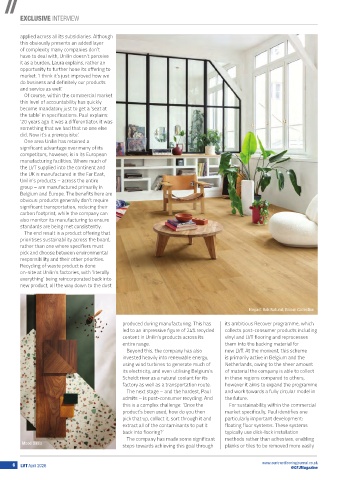
                                                                                             Elegant Oak Natural, Bloom Collection

                                                produced during manufacturing. This has   its ambitious Recover programme, which
                                                led to an impressive figure of 24% recycled   collects post-consumer products including
                                                content in Unilin’s products across its   vinyl and LVT flooring and reprocesses
                                                entire range.                       them into the backing material for
                                                  Beyond this, the company has also   new LVT. At the moment, this scheme
                                                invested heavily into renewable energy,   is primarily active in Belgium and the
                                                using wind turbines to generate much of   Netherlands, owing to the sheer amount
                                                its electricity, and even utilising Belgium’s   of material the company is able to collect
                                                Scheldt river as a natural coolant for its   in these regions compared to others,
                                                factory as well as a transportation route.   however it aims to expand the programme
                                                  The next stage – and the hardest, Paul   and work towards a fully circular model in
                                                admits – is post-consumer recycling. And   the future.
                                                this is a complex challenge: ‘Once the   For sustainability within the commercial
                                                product’s been used, how do you then   market specifically, Paul identifies one
                                                pick that up, collect it, sort through it and   particularly important development:
                                                extract all of the contaminants to put it   floating floor systems. These systems
                                                back into flooring?’                typically use click-lock installation
                                                  The company has made some significant   methods rather than adhesives, enabling
             Mood Oasis                         steps towards achieving this goal through   planks or tiles to be removed more easily


          6  LVT April 2026                                                                       www.contractflooringjournal.co.uk
                                                                                                            @CFJMagazine

